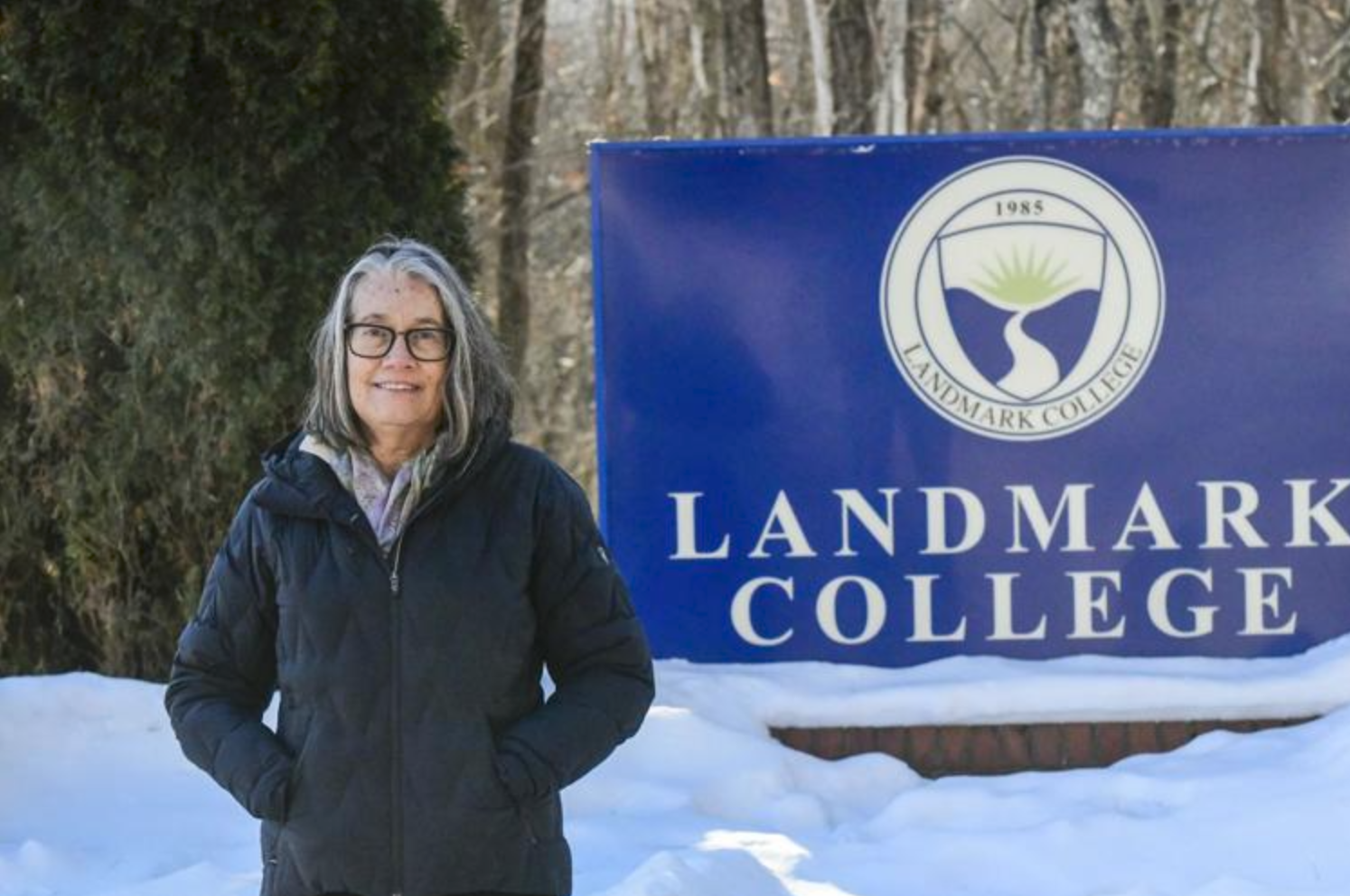
Dorothy (Dotti) Osterholt is the daughter of the 95 year old Betty Kennedy of the previous profile for this newspaper. Dotti was born in 1956 in Norfolk, Virginia. Five years later, in 1961, her family moved to Concord, Massachusetts. In 1975, Dotti graduated from Concord/Carlisle High School. In a very real sense two experiences during that time motivated her future.
First, she became interested in writing. The fabric of the Concord School System was interwoven with the lives of the American writers who had lived there roughly 100 years earlier: Henery David Thoreau and Ralph Waldo Emerson among others. Dottie and her older sister Joan learned how to swim in Walden Pond. During her high school years, she got her first 35mm camera and rode her bike to Walden Pond and into the surrounding woods. There she photographed morning mists rising. She later compiled those images into a finely prepared portfolio.
During her high school years in the early 1970’s, desegregation and bussing of students from the black community of Roxbury to decidedly white Concord-Carlisle High School started up. Dotti watched how the Roxbury students stayed among themselves (as did the white students) while the high school did little to integrate the black kids into their community. “They were in our school but not of it. I also had a friend who had lived in Roxbury. I’d visit her often and she told me how the economic limits of the lives of black families in Roxbury were countered by strong black families. They were engaged. They brought their kids up in deeply caring ways. Families were strong. They fought against busing in order to keep their community together.”
After graduating in 1974, she went to Baypath College in Longmeadow, MA for two years to study early childhood education and earned her Associates Degree. “While there I landed an internship in a very unique pre-school where 50% of the children had various disabilities while the remaining students had no disabilities. It was, for the time, a cutting-edge school integrating the able with the disabled. (The three to six year olds needed no help to get along together.) I looked back at the Roxbury kids coming to Concord and realized how they, and disabled kids in the school, had not been integrated. I realized segregation is learned. At that forward-thinking pre-school, ramps were set up for wheelchairs, accommodations were everywhere for mobility, for the hearing and visually impaired kids….. This was one of my first lessons in equity. I was nineteen and I look back and realize this was the beginning of my life’s journey.
“After earning my Associates Degree I attended Salve Regina College in Newport, Rhode Island and graduated with a BA degree in Special Education. While there I was involved with families of severely hyperactive kids. I worked with mothers advocating for removing harmful additives to food. Around the country at that time, food labeling began to appear as a stay to harmful additives. I talked to mothers. We were part of a nationwide effort to address the relationship between diet and learning disabilities.
“With a BA degree in 1980, I took a job at Landmark High School in Beverly, MA. I taught English there to exclusively dyslexic students who had difficulty processing language and therefore had difficulty with reading, writing and speaking. I learned how much growth resulted for these kids with the right kind of education. (A Landmark program also started in Los Angeles during this time.)
“During my time at Landmark School, I was a teacher supervisor from 1983-1985.In 1985 David Osterholt from Malden, MA and I married. That same year Dr. Drake, founder of Landmark School, considered where and how we could establish a college for dyslexic students. Dr. Drake asked me to be a member of the founding faculty. He purchased the campus of Windham College in Putney, Vermont that had closed in 1975 and had lain moribund since then.
“David and I, along with other faculty and administrators, saw the campus for the first time in April, 1985. We learned the campus was originally designed by the famous architect Edward Durrell Stone. It was a campus meant to be constructed in Phoenix, Arizona, a design that was never put into bricks and mortar. Windham College purchased and installed Stone’s blueprint around 1962 but closed in 1978. The campus lay moribund until early 1985 when Dr. Drake and the board at Landmark School decided to purchase the entire property. We who were looking at the campus with an eye to the purchase of it were amazed and apprehensive. The campus sprawled over many acres: dorms, classrooms, administration building and dining facilities……. BUT water was running down the interior walls of the flat-roofed buildings of the campus that had been shut down for seven years. After these problems were solved. it would shortly become Landmark College. We opened the doors to seventy-seven students as a college September, 1985.”
“Jim Oliver from Putney was hired as the first president. His wife Caroline oversaw the admissions office in charge of finding students. Geoff Gaddis was the financial officer. Although it was a “heavy lift”, we developed an inner support system to create commitment. The teachers, administrators, kitchen and maintenance staffs, everyone who had any contact whatsoever with the students, worked together to support the students. Our mission was to change the way teachers taught and students learned. (Not until 1995 did the American Disability Act pass in Congress.)
“In 1989 our daughter Emily was born and now works for Tulane University and lives with her husband in Georgia. In 1995 our son Daniel was born. He’s in Washington State and is building his own company as a photographer and graphic designer. In 2001 I earned a Masters in Education from Antioch University while writing about our success in the classrooms at Landmark. I wrote numerous articles for, among others, The Journal of Developmental Education and other professional journals. Sophie Dennis and other colleagues and I did a lot of presentations about our successes and approach at Landmark. We presented in Vancouver, BC, Montreal, across the US, in Manchester, England., Hofstra University and did training at The University of Pennsylvania. During this time, companies were starting to support neuro-diverse employees while I was helping students transition from college to work. I retired from Landmark College in 2023 after working there for thirty-eight years (and 42 years teaching neurodivergent students). We lived in our home in Westminster West during my time at Landmark College.
“My mother Betty moved to live with us to our home in 2018. She has her own wing of the house and we share the cooking. She is remarkably resilient as her earlier profile in The Reformer shows. She keeps herself educated about the news, but above all she loves people. She too was my inspiration, both as a lifetime nurse and as a woman who championed racial integration and concern for the ill and disenfranchised. Although I’m retired from teaching, I continue to write. My focus is on all that I learned from my students and the value of integration and equity for all.”
©Kristopher Radder Brattleboro Reformer