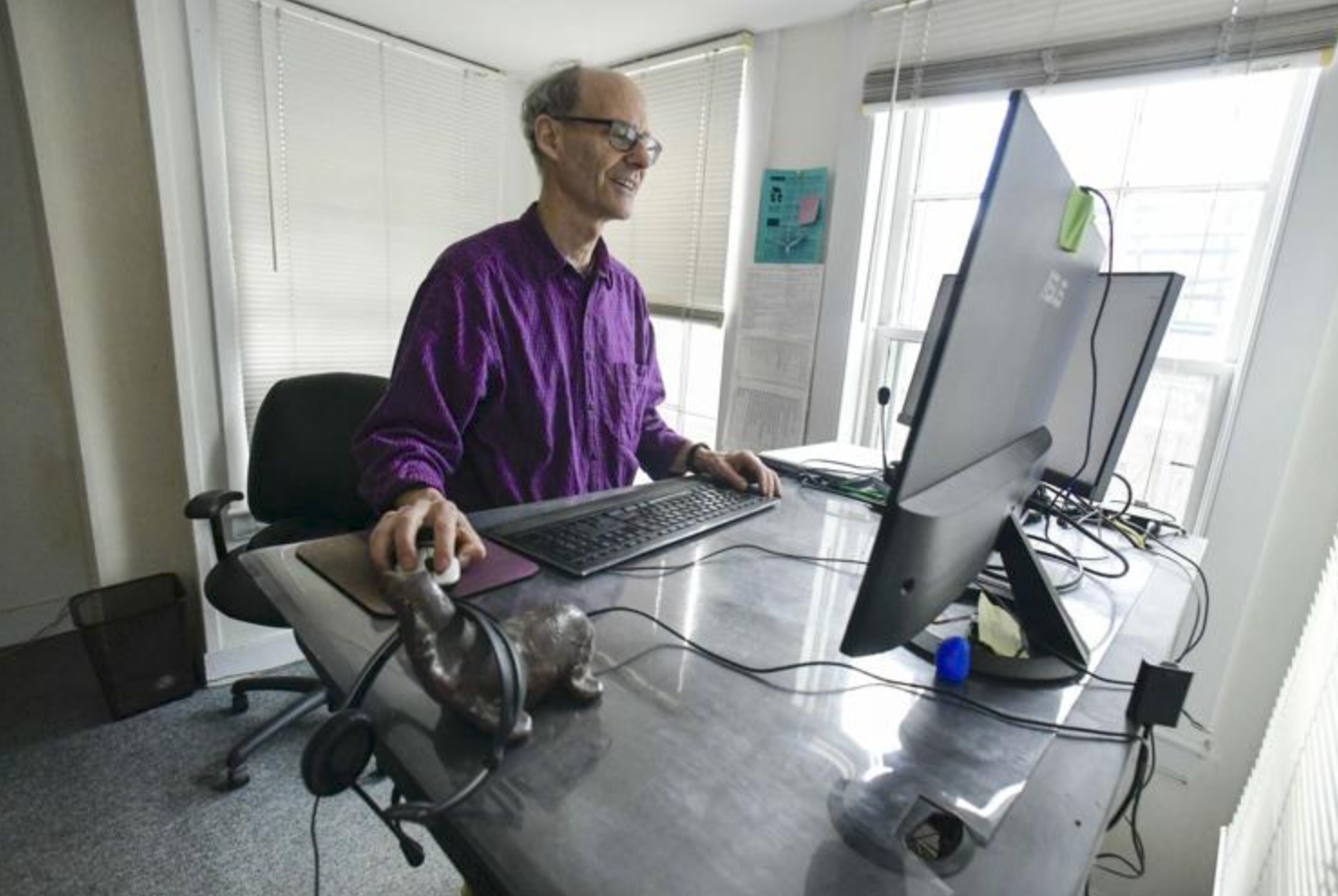
Philip Hamilton, 64, lives in Westminster West, VT with his husband and chef Tim Allen while he works remotely at the New England Aquarium in Boston. And it has been research into the lives and data-collection regarding the North Atlantic Right Whale that has held his focus while he has moved around New England. Philip was born in July, 1962 in Santa Fe where his father, Mike Hamilton, worked with influential architect Alexander Girard. (He has an older brother Doug as well as an older sister Kim).
When a boy, his family moved to Buffalo where he split his year between the city and a summer home in Canada on the shore of Lake Erie. By the age of five he was tracking animals and learning bird calls in a vast field near their summer home. He became the local naturalist called upon to relocate nuisance squirrels. From a young age, he always loved and collected all the field guides: mammals, birds, reptiles, trees…..
“I went to Nichols School in Buffalo for high school where I studied ballet and played soccer. Biology was my favorite class. Because we had no TV at our summer home, nature became my hobby which I shared with our German Shepherd dog Bigit– we *went* everywhere together in the woods, fields, along streams. “Nichols was where I learned to write. We had to write papers about the writers we were reading IN THEIR STYLE.
“In 1983 I enrolled at SUNY in Binghampton. I waited tables to help pay my way and graduated in 1986. I majored in environmental studies – that is, I studied who I am – a man with a deep sense of caring for the natural world. I studied birds, fish, amphibians, mosses, plants and became proficient in Spanish.
“After graduating, I saw a job announcement in an environmental job newsletter for a position as a whale biologist in Provincetown at the Center for Coastal Studies. Having never seen a whale, I applied. A few days later, I drove to Cape Cod and showed up at their door. It was a competitive job- one of the few paying starting positions as a whale biologist. I got the job.
“It was to go out with a research crew of four on an old, slow lobster boat during the winter in Cape Cod Bay to photo-identify North Atlantic right whales. (They were named “Right Whales” by New England whalers in the 1800’s because they yielded high-quality oil.) I photographed the callosity patterns on the heads of the whales- areas of roughened skin colonized with white whale lice which highlight the pattern and placement of the callosities. Because these form different shapes and appear in different locations on the whale’s head, they become identification markers for each whale- much like a fingerprint. We gave a catalog number to each whale, and some were given names.
“I stayed with The Center for Coastal Studies from 1986-1989 when I took a job with the New England Aquarium in Boston. There I studied right whales in the Bay of Fundy and Roseway Basin south of Nova Scotia. With six or so colleagues, I’d captain the*Nereid*, our 29’ inboard Dyer, which was open to the elements where waves could get very big very fast.
“We left the harbor at 5:00 AM and got to the site in the Bay of Fundy around 8:00 AM to begin searching for right whales and photographing them for ID purposes. We saw seabirds such as shearwaters and petrels were whirling above us, the dorsal fins of 30’ basking sharks moving lazily through the water. We’d see the flash of bluefin tuna as they darted by and occasionally fin or humpback whales spouting.
“The implications of climate change for right whales began to take hold around 2010-2011. Every site we were studying was disrupted- right whales abandoned some areas and moved into new areas. Planning became uncertain. By 2020, we stopped our research in The Bay of Fundy after 40 years because so few right whales went there. Although the North Atlantic Right Whale Catalog , which I have managed for years, has 834 whales in it, the living population is only around 380. They inhabit a coastal area up to 50 or so miles wide from the tip of Florida up to and including Newfoundland and the Bay of Fundy in Canada.
“I have also had the opportunity to study humpback whales and that has taken me to areas from Antarctica to Greenland. That’s where I first learned to use a crossbow with a tissue-collecting tip on it to collect biopsies. Once, off the coast of the Dominican Republic, I needed to get a tissue sample from a newborn humpback calf. We were doing ten knots in a zodiac when I sensed when the calf we had been following would surface. Intuitively, I let the arrow fly. The calf rose just at the moment the arrow reached it. We sent that sample to a laboratory in Denmark for a population estimate study.” (Philip also did field work off Ireland, South Georgia Island in the South Atlantic, Bermuda, Greenland, Dominican Republic, Chile and the Antarctic Peninsula to name a few.)
“During the peak of my identification skills in the late 90’s (before I got pulled into more of a desk job), I knew almost all the right whales on sight. Once, I saw a group of forty males with one female in a social group and I could identify all of them. I knew their habits, their histories…. Today, right whales don’t live to a ripe old age into their 80’s and beyond. They are killed by vessels strikes or they get entangled in fishing ropes, in part because they inhabit water only 50 miles out in the sea from the coast of North America and Canada- a very busy area for both vessels and fishing gear. These deaths became more frequent starting in 2017.
“Over my time at the Aquarium in Boston, my work shifted to developing and managing the database and software necessary to organize the vast data and images we had gathered. In 2003, I succeeded in getting a National Science Foundation grant to integrate digital photography with the hundreds of thousands of prints and slides so we could manage them via computers. I’m now integrating video footage into the software and revamping our whole system of record-keeping and moving it to the cloud. I wrote grant proposals and co-authored around sixty peer-reviewed articles. From 2022-2025, I served as the interim chair of our research program at the Aquarium.”
“I moved to Putney in 2001 from Cambridge, MA after meeting and falling in love with Tim in 1999. I wanted to live in nature, not just visit it. Tim and I wanted the same thing. We rented a house in Putney for five years during which time I got my Masters at UMass in Boston. In 2006, we bought a home in Westminster West. People come to Vermont to grow, and all the schools and colleges around here seed this community with thoughtful, curious people. While I continue my five-day-a week work for the Aquarium remotely from my office in Putney, my heart is solidly here in Vermont. To learn more about our work and see photos of right whales in the catalog, visit rwcatalog.neaq.org.
©Kristopher Radder Brattleboro Reformer