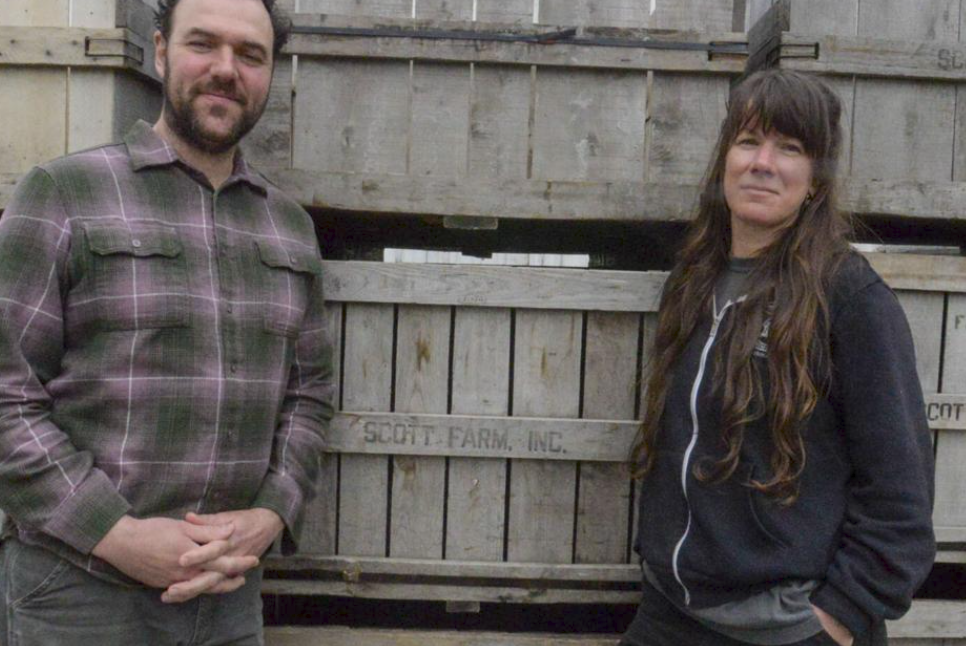
DUMMERSTON — Erin Robinson, a Dummerston native, grew up in the 1980s. Her mother, Teri Robinson, taught for decades at Dummerston Elementary School. Her father, Denny Robinson’s, history also runs deep as a part of the multi-generational Robinson family from Dummerston and Wardsboro. Erin attended Vermont Academy from 1996-2001 in Saxtons River, throughout those years working part-time and summers in the vegetable fields for Jack and Karen Manix at Walker Farm along with MANY other people her age learning to tend crops.
After high school Erin looked for a change. She lived in Mesa, Arizona from 2002-2004 but realized that was not her place. Her roots in Dummerston were too deep, too appealing a community to turn away from. She took a temporary apartment rental at Scott Farm and took on various jobs while also working for a few years at Beadniks in Brattleboro.
In 2008 she became a mother to her first son Evan. She began to take on more part-time work for the owner of the farm – The Landmark Trust USA - while also cleaning and looking after Rudyard Kipling’s 1892 home, Naulakha, also owned and rented out to visitors by Landmark Trust USA. She worked in the sugarhouse, painted and did other jobs until 2013. That year everything changed: she was asked to fill in for Heirloom Apple Day, and subsequently asked if she’d have any interest in pruning that winter. She’s still there.
In 2014 she had her second son, Boden, while her roles at the farm continued to develop: managing the retail market, pressing cider, working with the crew fulfilling orders, mowing, pruning, getting to know the orchards well... In early 2020, Zeke Goodband, who had developed this extraordinary heirloom apple orchard, moved on, leaving the role of Orchardist open. She applied for the job; her knowledge was put to the test. She agreed to take on the task in an interim position and since has managed the 25 acres of orchards and is now in her 6th season as Orchardist of Scott Farm.
In 2020, when the orchard and operations management underwent this significant shift, Susan McMahon, the Executive Director of The Landmark Trust USA, also hired Simon Renault as General Manager of the farm based on his farming and community engagement experience. (He also had been a graduate student in education in nonprofit management.) He would work hand in hand with Erin and still does.
Simon Renault (pronounced "see-mon") was born in Rennes, France in 1979 to Maurice and Marie-Claire Renault who lived in Redon, a small town in the province of Brittany in NW France. Simon’s parents and grandparents share a deep cultural and Celtic identity, as do all Breton people, that dates back centuries. In the 1500's Brittany was a country with its own Queen. That regional identity was deeply rooted in farming and self-sufficiency, with apple orchards in particular at its core as well as sweet and hard cider as the national drink. He remembers picking apples in his grandparents’ orchards.
But with his parents’ generation growing up in the post-war ’50s, that link to the past ways of agricultural life began to break down as it did across the Western world. His father was a professional helping non-profits organize their businesses. Simon attended Redon High School in its magnificent buildings, some of them dating back to the 800s. He graduated in 1997. He enrolled in The University of Rennes where he studied law for two years but said “I got a little bit lost.” He moved to The University of Limoges, studied the arts and nonprofit administration, “still looking for what moved me.
"After four years of college, I was still asking what should I do to live a wonderful life? I kept thinking about my life growing up near the vast Forest of Brocelaine in Brittany with its Celtic History. This was the forest that gave rise to so many of the King Arthur legends; it was where Merlin the Magician lived. I studied 3,000 years of Celtic history."
“In February 2003, I moved to the thinly populated and deeply Celtic island of Inishmore, one of the very thinly populated and still timeless Aran Islands off Galway Bay in Ireland. (By coincidence, this island was also the place where filmmaker Robert Flaherty, who at one time had lived in Dummerston, not more than a few miles from what is now Scott Farm - had lived and made his film Man of Aran.) I heard of an Irish family who were welcoming people from across Europe to come to Inishmore to learn about farming and self-sufficiency. I wanted to learn about old models of farming as well as new ones.
“I worked with the 'Woofers' movement volunteering my time from 2004 – 2006 for 2-3 months at a time on organic farms across Wales, Italy, Spain, France... In 2007 I moved to Oregon in the US to study permaculture. That’s where I met Dana Boyd. We fell in love.”
In 2008, Simon and Dana, after visiting various friends and family in New England, decided to move to Putney, Vermont. They settled at Sun Hill Farm, which Simon managed for 10 years. There, they raised their growing family. They have three children: Sky, Malo and Louie. He established his US citizenship.
“In 2020, Susan McMahon hired me as the general manager of Scott Farm in Dummerston. In a way, I had come full circle, although across the Atlantic. The history of the farm with its 25 acres of old varieties of apples, drew me in. It had been a farm since 1791 and then, in 1913, the Holbrook family started creating an 80-90 acre orchard there with primarily MacIntosh apple trees. In 1995 Fred Holbrook donated Scott Farm to The Landmark Trust USA. Because I am NOT an orchardist, my skills and knowledge matched well with Erin Robinson’s who already had years of experience working with Scott Farm apple trees.”
Erin told this writer: “Since 2013 I made cider, helped in the packing room, and fell in love with apples. I knew the crew of Jamaicans who came every year to help with the harvest. I knew the ins and out of the whole operation. I pruned in the winter and became passionate about the vast range of apples and their histories as well as the pears, peaches and plum varieties. We grow 142 varieties of apples. We sell 65% of those apples to food coops, food distributors, specialty shops, cider makers and have our own retail shop on the property. By selling to small outlets, the orders consisting of so many varieties are complex, requiring great care in packing and distributing. And this entire orchard operation is certified as “Eco Certified” by The American Integrated Pest Management Institute.”
Simon added, “We are now starting to expand our cider making of mixed as well as single-variety ciders into a new product: fermented alcoholic or “hard cider”. Simon remembers as a boy, “I saw hard cider served at the lunch and dinner tables as a matter of course, especially in my grandparents’ farmhouse. For my grandparents' generation, it was THE beverage when fresh water was not always available. It’s a “common folk” drink. For the past five years we’ve been developing different blends of hard ciders using the same techniques my grandparents and father used in Brittany. It is often served with savory buckwheat crepes (galettes).”
One of the missions for The Landmark Trust is to engage in their community. As Simon pointed out, “In 2021, we started offering monthly ‘Crêpe Nights’ to help local non-profits here in SE Vermont raise money. We cover all the costs of making the meal. We serve one savory crêpe, one sweet crêpe, salad and we have an open bar with the best sweet and hard ciders. It’s a family event held on the first and third Wednesdays from May through August. We provide the food, sell the drink, and all proceeds go to a different charity each time.”
Local folks working the farm; Jamaicans picking most of the apples; a native Dummerston woman with two boys; a young family man from Brittany; heirloom fruit trees on land farmed since the 1700’s by local Vermonters. It’s all a remarkable local story, with Dummerston citizen and world-renowned filmmaker Robert Flaherty’s story thrown in for good measure!
Photo: Kristopher Radder, Brattleboro Reformer