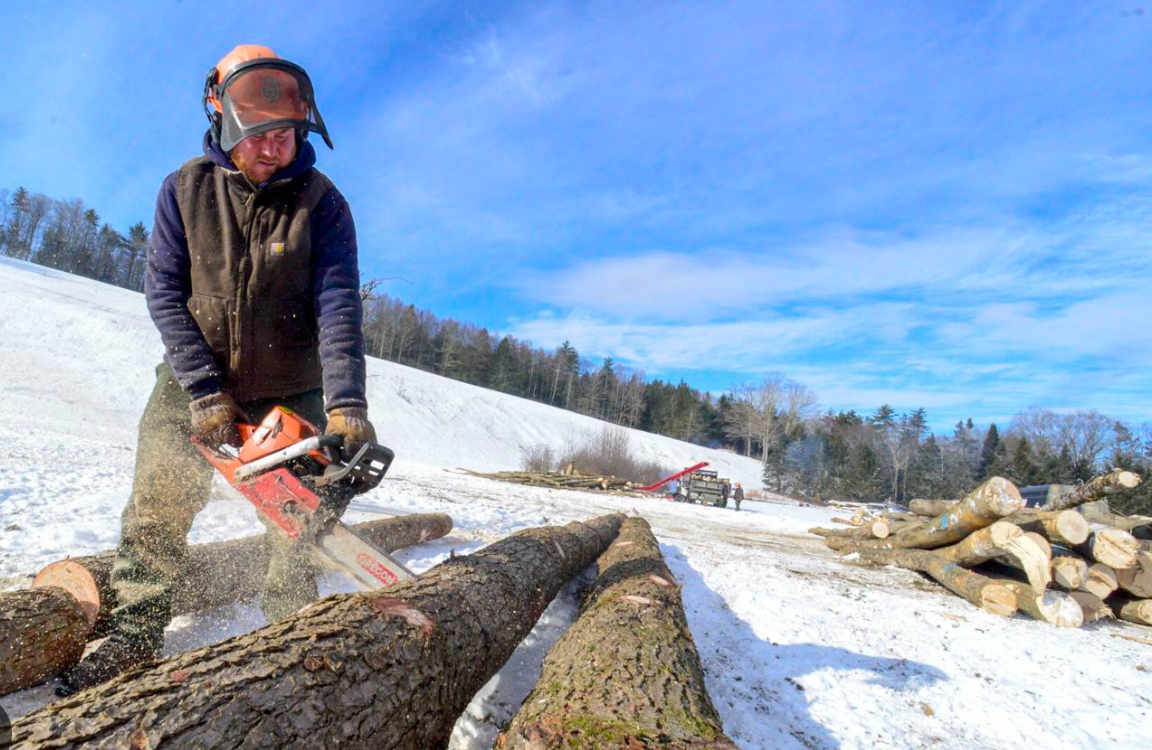
On Feb. 8, just a few days ago, Calvin Powling, Jr., a logger from Newfane, was called to the stage in an auditorium in Barre in front of hundreds of fellow Vermont loggers. The Vermont Forest Products Association named him “Vermont’s Outstanding Logging Operator, 2024” at the organization's annual meeting. The award declaration read: “A 4th generation logger trained by his father, Calvin, Sr., who continued logging until he was 89, possessing a reputation as a skilled, honest logger with a strong work ethic, with personal safety a top priority, valuing his relationships with landowners and foresters he works with. Working with his wife Toni and son Travis, continuing the legacy of the Powling family – a multigenerational legacy of families dedicating their lives to stewarding our forestlands. CONGRATULATIONS!”
Calvin Sr., born in 1925, grew up in Weston, Vermont, one of seven children born into a family of loggers. He went to grammar school through sixth grade but gradually shifted his attention to helping his family with logging. He remained an active logger his whole life. His son Calvin followed in his footsteps.
Calvin Jr. was born in Brattleboro in 1958. He grew up in Marlboro until he was 16. “When I was in seventh and eighth grade, I drove a skidder hauling logs my Dad cut. I loved the woods. Now that I’m older, I still love the woods, especially in the winter when you can see your breath in the air. The woods are clean. No mud. All the water is in the ground or in the roots of the trees. You see steam coming off the streams.”
He lived in Marlboro on Auger Hole Road until 16. He’s now 67. “I just couldn’t see myself working in a machine shop or something like that. I love working in the tall woods. I love the challenge. I just couldn’t sit in a factory. I need to hear the sounds of the woods: the streams, the wind, the birds and animals calling as well as the sound of chain saws, the skidder making its way down our logging roads...” Travis, his son, feels the same.
“My sister Sue is now 76; when 14, she skidded logs out of the woods with horses, then married a logger from Jacksonville. Betty Jane, now 78, married a logger who worked for our uncle and Dad: Powling Bros. Logging. And those were the days when chainsaws weighed around 50 pounds; today they weigh around 17 pounds. Someone in the family, or a hired man, would then drive loaded logging trucks to a mill on Depot Road in Williamsville or haul ash logs to Basketville in Putney where they made baskets. We’d haul to Cersosimo’s or Allard’s in Brattleboro.”
Both Calvin and Toni had been married previously with children but both had divorced. Toni and Calvin met and in 1999 she and her children moved to land that Calvin had purchased in 1985 in Newfane on which he had built a house. They lovingly combined their two families. They got married in early March of 2000 – mud season. It was the perfect time: they couldn’t work in the woods during mud season – heavy skidders dragging logs would have destroyed the ground – so they were free that week. Toni said, “I asked Calvin if we could get married on the opening day of deer season – the other time when we wouldn’t be working – but he said 'No' – all our friends and family we wanted to be there would be gone hunting: March and mud season it was."
It was clear from the start that Toni and son Travis would work with Calvin to make up the logging business. Toni, known to many as The Firewood Queen of Southern Vermont, keeps the bookkeeping for their businesses up to snuff. She also splits, loads and delivers truckloads of split firewood in her one-ton 2024 dumptruck – a Chevrolet 3500. (She often gets help from a guy running a chainsaw.) Travis and Calvin do the logging.
Calvin, Travis (who's married to Samantha Hackett from Richmond, N.H.) and Toni are out of the house by 6:30 a.m. – earlier in the summer – arriving at their worksite often before dawn. In the winter they first warm up the skidder with a big heater: ‘If the skidder doesn’t work, we don’t work.’ With its heavy 100-foot cable and chokers, Calvin hauls the several-ton logs out of the woods at a time.
All their hard work is supported by equipment valued at somewhere well past $250,000: four Timberjack 4-wheel drive skidders with 4’-6’ wheels, each skidder weighing up to 9,000 pounds; what they call a “small” log truck that can haul 50,000 pounds of logs that has a cherry picker attached to offload logs; conveyors, a dumptruck, pickups and no end of chainsaws. His regard for his chainsaws is suggested by Calvin’s memorial to them: a circular garden 30’ across in his back meadow. Within it, he placed 30 or more old chainsaws he couldn’t bear to part with. He added disused hardhats, an old cross-cut saw and wooden gnomes he makes to give away. It’s all surrounded by a circular, low dry-laid stone wall centered on an old hemlock tree.
And who does Calvin and family work for? Homeowners. If you have woodland that needs clearing or managing, you would first call a forester registered by the state of Vermont, a state that looks after its woodland with considerable care. Calvin has worked with Lynn Levine from Dummerston, a registered forester who is a member of The Society of American Foresters since 1978 and the very first female forester in the Northeast.
Lynn has worked with around 150 homeowners here in Southeastern Vermont who were considering logging their woodland, whether for firewood, for selling mature trees, or were concerned about the long-term health of their woodland. “At first, I was disrespected by virtually all loggers. That was a man’s world. None of the Powlings ever treated me that way. They said I was part of their family. In fact, whenever old Mr. Powling saw me arrive on a jobsite, he’d come up to me and give me a peck on the cheek. When he died, I gave the family a little wooden logging truck I bought and painted “Powling Logging” on its side. They put it in Mr. Powling’s casket.”
As a forester registered with the state, Levine gets a call from the owner of a woodlot who wants to manage it well. She writes up a 10-year forest management program. Levine explains: “If you want to reduce property taxes, you need a professionally written 10-year land-use plan that addresses the ecology of your land, logging details, water management during and after logging. I write recommendations for the site, mark trees, work with Calvin on many jobs – He’s my go-to guy – to determine the best temporary locations for logging roads, which areas to thin, where to create shelter woods for wildlife...”
With this report accepted by The Forestry Commission of Vermont, Calvin and his family begin their careful work, but, as Calvin said, “No matter what, it always looks like a mess when we’re finished and that upsets a lot of people. But go back to the spot 5 years later and you see a renewed forest.”
So what do these loggers do on weekends? Toni says, “I spend my time being a wife and Mom. I bake and cook – I love to bake – read my book and listen to his chainsaw. Friday evenings in summer we often go to our 26-acre camp in the woods in Dummerston for the weekend. No TV, no phone. We can see Mt. Monadnock from there. Calvin makes his humorous wooden sculptures. One time he even made a ring for Lynn Levine out of deer horn. Calvin also seeded a large area of cleared woodland years ago so deer could come year-round to graze." They sit on the porch some evenings and watch the deer graze as the sun goes down.
And every fall they drive to Erie County, Pa., just below Buffalo, for a week of deer season. Last year they returned to Vermont with coolers full of deer meat for the winter. Toni said, “I got my buck – a four-pointer – with my crossbow – I usually hunt with a 243, Calvin with a 30-06 got a four-pointer too, Travis – with the 30-06 that Calvin bought for him as his first rifle – got an eight-pointer.”
Photo: Kristopher Radder, Brattleboro Reformer